Why Would Anyone Invent a Laptop?

A Tale of Two Economies


It was the late 1980s. I was living in the United States and had traveled to India. I visited a friend at his office and since the work day was ending, he invited me to his home. He was, by Indian standards of that era, a man of considerable standing – one of the rare few who owned a desktop computer!

As we prepared to leave the office, he shut down his machine. Then he turned and called out to the office peon. “Yeh computer gaadi meh rakh do,” he instructed. Put this computer in the car. The peon nodded, hoisted the machine, and carried it two floors down to the waiting vehicle. When we arrived at his home some time later, my friend turned to his driver and said, “Computer upar le jao, mere table pe rakh do.” Take the computer upstairs and put it on my table. Up the stairs went his driver – to the “first” floor – and disappeared from sight. I am sure this was repeated in reverse the next morning.

I watched all of this with a quiet smile. I thought of my computer back in the US – an IBM portable machine, with a 9-inch monitor, a little lighter and smaller (but not much) than my friend’s desktop.

IBM Portable Personal Computer — the original 'luggable'
The IBM “luggable” – portable in name only.

It wasn’t elegant. It was what people charitably called a “luggable.” But I carried it myself, everywhere I went (mostly to the university and back to my room), because that was simply what you did.

Years later, recounting that memory, a thought crystallized into something I haven’t been able to shake since: Why would anyone in India ever invent a laptop? When you can substitute the solution with captive labor, the problem – as far as the market is concerned – doesn’t exist.


The Invisible Cost of Cheap Hands

That moment in India isn’t just a cultural curiosity. It’s a precise illustration of one of the most consequential economic divergences of the modern era: the radically different relationships that India and the United States have developed with labor and technology.

Consider the contrast hiding in plain sight. A software engineer in New York earning $200,000 a year cooks his own meals, vacuums his apartment, and scrubs his own bathroom. A professional in India earning $20,000 (almost ₹20,00,000) a year employs a cook, a maid, and a driver. Many Indians see this as a reason why “India is better” to live in. I see it as a sign of “India’s Demographic Disability.”

One theory traces back to 1954, when a Nobel Laureate, W. Arthur Lewis, posited that developing economies grow by evolving from a traditional, labor-heavy agricultural economy to a machine-centered, industrial economy. The model predicts that as surplus labor migrates from farms to factories, average wages rise and the economy prospers.

America, for the most part, played out exactly as the theory predicted. Manufacturing soaked up the workers flooding in from farms. Paychecks grew. The cost of a person’s time rose with them. And once labor gets expensive enough, people start building things to replace it. The Roomba isn’t a product born from some American fondness for robot gadgets – it’s the inevitable result of a society where paying someone to push a vacuum costs more than engineering a device that does it on its own.

India never got that far. It found itself at a fork in the road and, for reasons structural and historical, missed the turn entirely.

A Ladder That Was Never Built…

Today, roughly 45% of India’s labor force works in agriculture – yet that sector produces only about 15% of the country’s GDP. Millions leave rural areas every year in search of opportunity. But because India never developed the manufacturing backbone that absorbed surplus labor in the West, there aren’t enough factory jobs waiting for them. They flow instead into the vast, informal urban economy – domestic workers, street vendors, delivery runners, office peons.

When the labor supply is effectively endless, wages collapse to match. That is how a human being ends up being paid ₹1,200 a month to wash dishes. The machine to do the same job costs almost 40 times that. That is how a desktop computer gets a two-person logistics team for a twenty-minute commute. Twice a day. Every day.

This isn’t “a better life” for the 98% of Indians who live at a subsistence level or just above. It’s a grinding cycle of poverty dressed up as convenience for the 2%.

The maid isn’t affordable because India is flourishing. She’s affordable because she has nowhere else to go. And crucially, as long as she remains that affordable, the incentive to build the machine that could replace her – or free her for better work – simply does not exist.

…And One That Was

Andrew Carnegie is the quintessential “rags to riches” story of the machine age, rising from a penniless Scottish immigrant to the world’s richest man by fully embracing industrial mechanization and steel production. Born in 1835 in Scotland, Carnegie grew up in a one-room weaver’s cottage and was so poor his family immigrated to America to escape starvation.

Enter The Machine: At age 13, he worked as a bobbin boy in a Pennsylvania textile mill, changing spools of thread for $1.20 a week. He embraced technology – moving into telegraphy, which was a “new age” technology, and later became a railroad superintendent – another new technology of that era.

Recognizing that the future was in industrialization, he focused on steel, utilizing the latest, efficient Bessemer process, which allowed for massive, low-cost production. By 1889, his Carnegie Steel Company was the largest in the world, and he eventually sold it for $480 million, becoming the wealthiest person of his time.

Another great example is Henry Ford, who started as an apprentice machinist and built his fortune by pioneering the moving assembly line to automate car production. There are many such stories (McDonald’s, Singer, John Deere) where innovation and industrialization created enormous wealth.

History – the Yoke or the Catalyst

To understand why America and India’s paths diverged, one has to only look at the last few hundred years or so of history.

The British found a prosperous (albeit medieval) sub-continent and plundered it until it became one of the poorest nations in the world. India emerged as an independent nation about 75 years ago – a nation devoid of industry and only enough infrastructure to rapidly ship goods back to Britain.

However, even before the British came, India was a loose affiliation of princely states and self-styled kingdoms. And outside of the princely courts, the sub-continent consisted of predominantly agrarian economies characterized by a decentralized, feudal structure, and high land revenue extraction. Agriculture was the backbone, with peasants heavily taxed to support the nobility. This meant that having a large number of children to support farming and other income-producing activities was the evolutionarily and economically (same thing, I know) best strategy for survival. This had social ramifications that still reverberate today – in the form of the highest population and one of the highest population densities in the world. The fuel and the engine for the endless supply of labor that exists till today. The yoke.

America on the other hand was sparsely populated when the European settlers began to arrive in the 17th century – on the cusp of the Industrial Revolution that was to follow. And even those that arrived initially were small in number. The pioneers that settled the west were called “Homesteaders” who took advantage of the Homestead Act of 1862 to claim 160 acres of federal land per family. They were required to live on the land, build a home, and cultivate it for five years to “prove up” and gain official ownership. A small family of three to six people controlled more land (even then) than that occupied by 10,000 people in India! Even with much larger families (Mormons and other conservative Christian families were often very large), the population density was low.
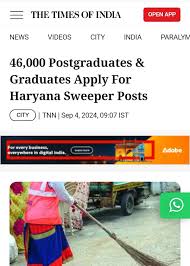
46,000 college graduates apply for a menial position /><figcaption style=46,000 college graduates apply for a menial position in the state of Haryana, India.

Those Early American pioneers turned to mechanization. By using machines, a small number of people could tame large tracts of land and build surplus. And there were enough resources that they could build simple machines – initially out of wood that grew on their own land. Great wealth was created and trade flourished. And mechanization became part of America’s core culture.

Twelve Indians share one American’s space – and one American’s worth of opportunity, divided twelve ways. Think about what that does to the price of a human being.

Technology Delayed Is Progress Denied

Many years after my India visit, I moved to India in the middle of building a cool product – an automated television recorder – a device that let you record shows, pause and rewind live TV. It was similar to the famous TiVo but it had some cutting-edge features such as the ability to capture streaming video and (legally) distribute video using torrents! The video was automatically encrypted and could be watched only by paying the original author. I was excited about it. I showed it to people in India. The reaction, more than once, was a shrug: “If I think I might miss a TV program, I just tell my maid to record it on the VCR.”

And there it was again. The same logic. Why invest in solving a problem when a person standing nearby will solve it for a fraction of the cost?

The answer, of course, is that the nation pays dearly for that bargain – just not immediately, and not in ways that show up on any individual’s balance sheet. Technologies don’t get invented – because there is always a short-term, cheaper human substitute. And so the country stays a step behind, then two steps, then a generation.

Meanwhile, the engineer in New York – who has no maid and no peon and must carry his own computer – creates the laptop, builds the Roomba, and writes the software that eventually automates tasks across entire industries. Cheap labor in India defers invention or even adoption.

This is the deeper trap, and it is a trap that compounds over time.

The Real Status Symbol

There is nothing wrong with domestic employment – in a well-functioning economy, household work is legitimate work, and those who perform it deserve fair wages and dignity. The problem is not the existence of domestic workers. The problem is the structural condition that makes their labor so cheap that it crowds out innovation, suppresses wages, and traps millions in a cycle with no upward exit.

When someone boasts about “affordable help,” they’re not showcasing their prosperity. They’re describing someone else’s lack of options – and, without knowing it, explaining why the next great invention probably won’t come from their corner of the world.

The real status symbol isn’t how many people work for you.

It’s whether the economy you live in gives everyone – including those who work for you – somewhere better to climb.


The laptop I lugged around in the late 1980s weighed a small fortune in effort. But that effort – multiplied across millions of Americans who had no one to carry things for them – quietly built the world’s most innovative economy. Sometimes the heaviest burden is the womb of innovation.

WANT MORE?

SIGN UP TO RECEIVE THE LATEST INSIGHTS, RANTS AND STORIES!

We don’t spam! Read our privacy policy for more info.

Leave a Reply

Your email address will not be published. Required fields are marked *

Pitch Decks

All the Public Startup Pitch Decks in One Place

30 Legendary Startup Pitch Decks And What You Can Learn From Them

The Best Startup Pitch Decks

Top 40 Best Startup Pitch Decks Of 2018 Which You Should ‘Steal’ From

The Early Pitch Decks Of 13 Startups Before They Became Billion-Dollar Companies

Pitch Deck Archive

OpenDeck.app

35 Pitch Deck Examples

PitchDeckHunt

Bestpitchdeck (780+ decks)

Comments are closed.

Happy New Year with ChatGPT

New Year Message

I was composing a message to send out for New Year, and I thought of using a new found friend for advice on writing it. So I charged up my browser and started typing…

Create a professional yet personal new year message from my company Podrones and myself

Dear valued customers and colleagues,

As the new year approaches, we at Podrones wanted to take a moment to reflect on the past year and express our gratitude for your continued support and partnership.

2020 was a challenging year for all of us, and we are grateful to have made it through together. We are proud of the hard work and resilience our team has shown, and we are deeply grateful for your trust in us.

As we look towards the future, we are excited to continue offering innovative and reliable drone solutions to help our customers achieve their goals. We are committed to continually improving and expanding our products and services, and we look forward to continuing to work with you in the new year.

Wishing you a happy and healthy new year,

[Your Name]

[Company Name]

Create a more positive version of this message and more oriented to others rather than our company

Dear valued friends and colleagues,

As the new year approaches, we wanted to take a moment to express our sincere gratitude for your friendship and support over the past year. It has been a challenging year for all of us, but we are grateful to have made it through together.

We are excited to enter the new year with hope and optimism, and we believe that with hard work and determination, we can all achieve our goals and make a positive impact in the world.

We are grateful for the opportunity to work with such talented and driven individuals, and we look forward to continuing to grow and learn together in the new year.

Wishing you a happy and successful new year,

even more oriented to the recipient

Dear [Recipient],

As the new year approaches, we wanted to take a moment to express our heartfelt appreciation for your contribution to our team and company. Your dedication, hard work, and commitment to excellence have been an inspiration to us all, and we are grateful to have you as part of our team.

We hope that the new year brings you joy, success, and all the things that you wish for. We believe that with your talent and determination, you can achieve any goal you set your mind to.

We are grateful to have you as a colleague and friend, and we look forward to continuing to work together and grow in the new year.

Wishing you a happy and prosperous new year,

[Your Name]

[Company Name]

recipients are customers and potential customers

Dear valued customers and potential customers,

As the new year approaches, we wanted to take a moment to express our sincere gratitude for your support and business. It has been a pleasure serving you, and we are grateful for the opportunity to be a part of your success.

We are excited to enter the new year with renewed energy and determination, and we are committed to continuing to provide top-quality products and exceptional customer service. We value your trust in us and are dedicated to exceeding your expectations.

We hope that the new year brings you joy, success, and all the things you wish for. We believe that with hard work and determination, we can all achieve our goals and make a positive impact in the world.

Wishing you a happy and prosperous new year,

[Your Name]

[Company Name]

Now create a short version for sending via WhatsApp

Happy New Year! Thank you for your support and partnership in the past year. We are excited to continue working with you and providing top-quality products and service in the New Year. Wishing you all the best for a happy and successful 2023.

Now create a New Year message for close friends and well-wishers

Dear [Friend],

As the new year approaches, I wanted to take a moment to express my gratitude for your friendship and support over the past year. It has been a challenging year for all of us, but I am grateful to have you by my side.

You have been a constant source of joy and positivity in my life, and I am grateful for the laughter, memories, and advice you have shared with me. I am so lucky to have you as a friend, and I look forward to continuing to grow and learn together in the new year.

Wishing you a happy and healthy new year, filled with love, success, and all the things you wish for.

With love and appreciation,

[Your Name]

Create a version for acquaintances

Dear [Acquaintance],

As the new year approaches, I wanted to take a moment to wish you a happy and successful new year. I hope that 2021 brings you joy, health, and all the things you wish for.

I am grateful to have had the opportunity to get to know you, and I look forward to continuing to connect and learn from one another in the new year.

Wishing you all the best for a bright and prosperous new year,

[Your Name]

P.S. Note that by default ChatGPT uses the year 2021. As the help page on the site says “ChatGPT is not connected to the internet, and it can occasionally produce incorrect answers. It has limited knowledge of world and events after 2021…” Presumably they stopped training it with fresh data around 2020.

And so I give you, dear reader, many thanx for reading this page on my blog and and best wishes for all the wonderful things ChatGPT thought of for you. And I also wish for you – Health, Happiness and Prosperity in the New Year!

Leave a Reply

Your email address will not be published. Required fields are marked *

Population Clock

Comments are closed.

Why I (a techie) want to head HR in my company

Many years ago, I heard an investor say that when they looked at an investment opportunity they looked at teams above everything else.  I was surprised when he said “You can make a spreadsheet say almost anything, so we just glance at the financials, and scroll down to the team slide”.  His last words on the subject were these (and they have stuck with me ever since):

“A B-Team will screw up an A plan, but an A-Team will fix a B-Plan”

I can’t remember his name but I remember his words.  This was in the oughts and I seem to remember he was from Bessemer Ventures, but I am not 100% sure.  Still it is remarkable that despite forgetting a lot of detail, that sentence has stuck in my mind.

I remembered his words because in two consecutive articles today I came across similar sentiments from investors.  The first one was from a blog post by Paul Graham writing about how they select teams for investment.

“If a group of founders seemed impressive enough, I’d fund them with no idea. But a really good idea will also get our attention—-not because of the idea per se, but because it’s evidence the founders are smart.”

Paul Graham (Co-Founder, Y-Combinator)

https://www.ycombinator.com/howtoapply/

Minutes later I was looking at excerpts from an interview of Karan Mohla, head of IDG Ventures, India.  At the end of the article is this nugget:

A great founder in a bad market can find good opportunities but that does not work the other way round.

Karan Mohla, IDG Ventures, India

https://inc42.com/features/moneyball-karan-mohla-of-idg-wants-to-reach-next-300-mn-indian-consumers/


Of course entrepreneurship is not just about fund raising.  I have seen time and again how companies (not just startups) have failed because of the lack of cohesive and well-executing teams.  I started with the investment thesis because it makes for great copy!  However, the reason investors look for good teams is precisely because a company’s success is most strongly related to a good team.

My favorite example of a failure is from eighteen years ago – when AOL and Time Warner merged.  It was touted as the mega-merger that would never be duplicated.  It was the coming together of the new economy with the old economy.  AOL had the infrastructure and the users (by then in millions) who were online, looking for content.  Time Warner had more than enough content.  This was to be the model of businesses in the future.  There was no one who could beat this behemoth because no one was bigger in the ISP business than AOL and the same was true of Time Warner in the Media business.

Unfortunately, they destroyed themselves and around a year later, the merger unraveled.  Why?  I am quoting from some article I read long ago (again!) but essentially the picture it painted was something like this.  Imagine a conference room with executives from both companies making plans and strategies for the new directions that the combined was going to take.  Time Warner executives are wearing three-piece suits, the AOL people show up in shorts!  There was no way they could talk to each other, leave alone collaborate.

This combined entity had the best brains, the infrastructure, the users and more than enough capital to have accomplished anything they could agree to.  And there’s the rub!  They were not a single cohesive team, and they floundered from the very first day because they couldn’t achieve anything together.

In other words, an entrepreneur needs to focus on building a great team, not on raising capital or anything else for that matter.  When you get a good team, or even the beginnings of one, it just gets easier to do the other important things such as building the product, finding customers and perhaps yes, even raising capital.  That is why, when people ask me what my long term role in the company will be I say Head of HR.  That surprises, them because I’m a techie to the core and most people know I like nothing more than slinging code and hardware with funky lights that blink.  But I know I can find others who (as a team) will do a better job.  And so, building that team, and the marketing team and all the other teams, is my real job.

One Response to Why I (a techie) want to head HR in my company

  1. Vasu says:

    Great article, specially true in the knowledge economy where the work first happens in the minds of the people.

Leave a Reply

Your email address will not be published. Required fields are marked *

Microsoft truly hates its customers (or gives a flying f**k about them)

Recently my Hotmail account on Outlook stopped working. I got various messages (I think Microsoft just makes them up) but the most common ones were:

Task ‘AG Hotmail’ reported error (0x8DE00005) : ‘There is an error synchronizing your mail account. Please verify your account is configured correctly by first accessing your mail on the web. Error: 3219. Server. An error occured in looking up the user’s information in mserv. ‘

Task ‘AG Hotmail’ reported error (0x8004102A) : ‘Error with Send/Receive. There was an error synchronizing your folder hierarchy. Error : 80041004.’

I spent hours spread over several days trying to fix the problem. I Googled extensively and tried practically every solution that was suggested including a clean boot, deleting and recreating the account in Outlook, reinstalling, repairing and many more. Nothing worked. Of course, in the process I lost all my Hotmail messages from Outlook, although I could read them online (which is a pain). Finally, I wrote up a question on answers.microsoft.com and received this tip:

When you login to your mailbox via the web, do you see “Preview” in the top-left corner? If so, it means your mailbox got migrated to the new Office 365 platform for Outlook.com.

What!?! Anyway, turns out that “I have been migrated”. Scary sounding, isn’t’ it? I am sure some message appeared in Hotmail that warned me that I was being migrated, but I didn’t take it seriously. And why should I? Let Microsoft upgrade, migrate, find new businesses, just let me do my work, OK? Well, I was very, very wrong. Read on…

Anyway, that tip led me to a page describing Outlook migration changes. There I learned that I needed to recreate the account with a connection to the Microsoft Exchange server. I went ahead and did that, thinking it would be seamless – but that would be too much to expect from Microsoft, right? After a couple of error messages and repeating every step, I was finally able to do the needful. As I write this, Outlook is resynchronizing my account and some emails have appeared.

But the saga is not over yet. Apparently the process makes the Hotmail account and data file the default. So it is like a “first time use” of Outlook. What does that mean you ask? Well, for one thing, it destroyed all my rules! Not only that, some rules no longer work because of some change in the software.  Luckily I had a backup of the rules from a couple-three of months ago. Unfortunately, I was in the middle of completely reorganizing my rules and had made major changes a few weeks ago – all those were lost. As I connect with people, I add them to my whitelist, and all those people I had connected with over the last three months are gone from the whitelist! Another few hours of unproductive time as I fix that (Grrrrr!).  Not Microsoft’s fault, of course, but then what do they care? A company that cares about its customers would have explained the whole process and warned about the loss of data. My Hotmail account is rarely used (one need not wonder why), and I could easily have done without it or checked email on the web rather than put up with this!

There’s more, but in the interests of brevity, I’ll stop ranting here and just say this:

  • Why don’t the programmers and product guys at Microsoft understand that we don’t want upgrades? We’d rather have stability. I really don’t have time to fix all the problems you create for customers.
  • Continuing with that thought, Microsoft Office, of which Outlook is a part is supposed to be “Office Productivity Software”. Instead, it eats up days at a time, with some arcane bug or the other. I really, really beg for an alternative. (And no Google Docs doesn’t cut it, unfortunately).
  • I am pretty adept on the computer, having used Windows since 3.1, but what about the poor souls (like my wife) who aren’t really into technology? Why should they have to put up with loss of data, loss of time, loss of money and extreme frustration because of Microsoft’s inability or unwillingness to care about it’s customers.
  • This is just one example of the exasperating problems that Microsoft creates for its users. In its other software and even in the Operating System there are tons of more examples. Of features that don’t work right, or don’t work logically, or are simply counter-intuitive.

Microsoft really needs to sit and observe customers who extensively use its software and learn to not infuriate them. I could have a dedicated blog just describing my daily frustrations with Microsoft.

So, this was long overdue Microsoft joins the list of #CompaniesWhoHateTheirCustomers

One Response to Microsoft truly hates its customers (or gives a flying f**k about them)

  1. voidlizard says:

    So good job, Microsoft. You’ve hijacked the software of a long time customer and made it unusable. If you think this is the way to get me to buy Office 360, you’re wrong.

Leave a Reply

Your email address will not be published. Required fields are marked *

Dear Facebook – We won’t get fooled again!

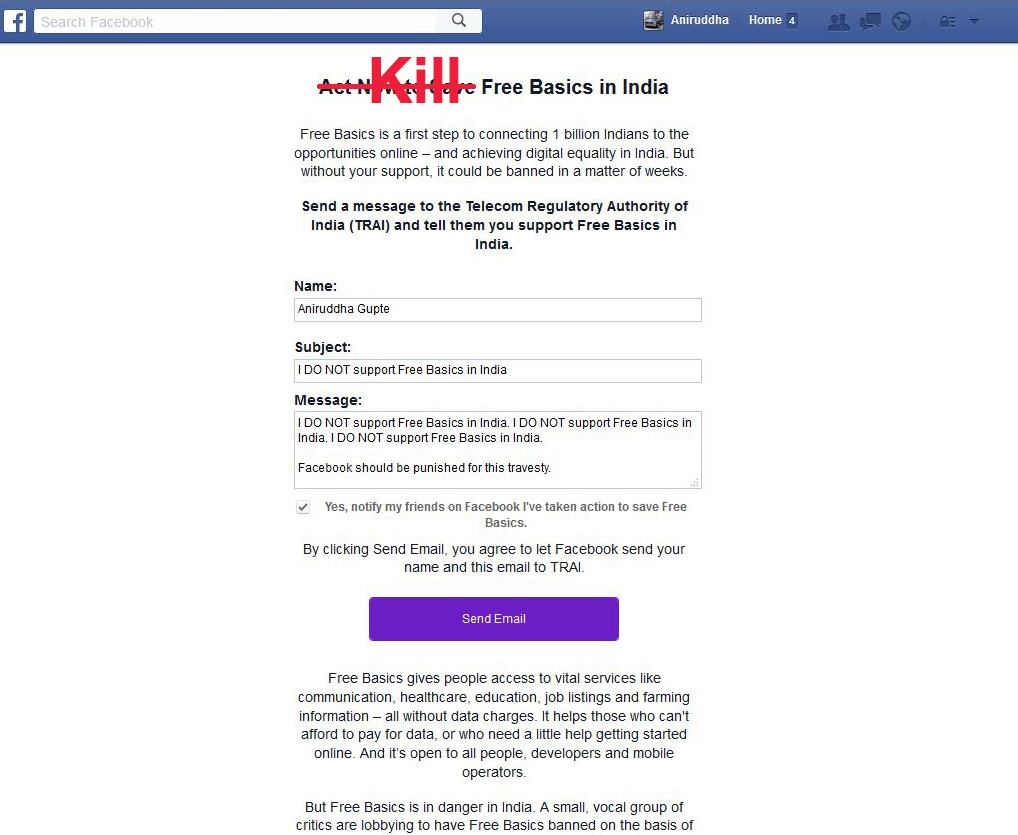
Facebook’s blatant attemptKill Facebook FreeBasics to kill Net Neutrality in India died last year when massive opposition from ordinary Internet users in India scuttled the project they called (sic) Internet.org. Now, resurrected right around Christmas (they should have waited till Easter J) under a different name – “Free Basics” they seem to have made inroads by signing up (according to them) over 800 developers and millions of ordinary users.

A number of very credible people have written very detailed and thoughtful criticism of Free Basics and the attendant double-full-page advertising campaigns.  Here are two of them:

Free Basics Is A Charmingly Seductive Do-Good Effort That in Reality is Sinister by Giridhar PaiGiridhar Pai, Sr. Vice President at National Bulk Handling Corporation Ltd.

Facebook is misleading Indians with its full-page ads about Free Basics by Mahesh Murthy, Marketer, Venture Capitalist, Corporate Speaker. Founder, Pinstorm. Co-founder, Seedfund

Microsoft too has criticized Facebook’s characterization of Free Basics (although that’s a little like Trump critiquing Hitler), saying that to describe Free Basics being compatible with Net Neutrality is misleading (Economic Times, Page 1, Friday 25th December).

I won’t repeat all the well-made arguments made in the articles I mentioned, but I do want to make three salient points:

  1. If Facebook really is interested in getting more people on the Internet, why are they limiting Free Basics to just their own site and a few others who have promised their fealty to them? Why not open up the entire Internet and subsidize access to those who can’t afford to access it otherwise? The answer is obvious – Free Basics and its predecessor are simply a naked attempt to shore up their bottom line, either soon or in the long term.
  2. Any kind of walled garden – no matter what/how good the intention, is anathema to a free, fair and democratic Internet. Even if (and I don’t believe it for a second) Facebook really is being altruistic, the moment any future manager at Facebook (Zuckerberg or anyone else) decides they have done enough “good” and want to cash in on the millions of users they have lured into their lair, they can. And it will be too late then.
  3. As part of their campaign on their own site, Facebook shares that 29 of my friends “…have sent a message to TRAI about Digital Equality in India”. TRAI, by the way is the Telecom Regulator in India, and so they make it look like my friends are part of a campaign to right a wrong in India. In fact, the wrong if any is being perpetrated by Facebook. There is no option to vote against the proposition, so to speak.

Bottom Line: Don’t support Free Basics or Internet.org; in fact let’s actively fight this and all other attempts on the fragile but important meritocracy of the Internet.

One suggestion: Use the form like I have to send the opposite message (see the graphic).

One Response to Dear Facebook – We won’t get fooled again!

  1. Retroqueen says:

    The world needs more people like you

Leave a Reply

Your email address will not be published. Required fields are marked *

The Greatest Must-Listen Rock Bands of All Time

Soon to evolve into a List of The Best Rock Songs of All Time

I wanted to make a list of all the songs I want to own, so I could go out and buy them. I do, of course already own some of them. I have bought them on Audio Cassette and CD/DVDs.   I began purchasing on iTunes too, but somehow my buying there was too haphazard. Hence the list.

Incidentally, I have listened to many on this list first on a Record Player (most of you don’t remember that gadget, do you?).

I also wanted to share them with my two boys (and perhaps their friends) so that they would have a list to refer to when want to explore really great music that has stood the test of time. And who knows, listening to these might keep them away from that Heavy/Death Metal crap (Not Music in my book). Of course, they already listen to a lot of what’s on this list so I know they have good taste. But to me it’s important that I tell them what I loved – whether they end up liking it or not.

I do want to share with my friends, so they can give me suggestions and fill out the list. This is a work-in-progress (I may have forgotten some obvious ones) so feel free.

Of course the most important part of making this list is pursuing a labor of love. Looking for, and then listening to the music brought back some great memories and is an unimaginably enjoyable task. The joy of rediscovering the Moody Blues for example was a skin-tingling rush that left me with a s**t-faced grin for at least a couple of days!

The criteria I have used to select these and also to rank them are pretty tight, but at the same time very personal.   I didn’t include breakaways like George Harrison and Neil Young explicitly; I think listing their band will be enough to remind me to include their best work.

Now, the criteria. First, I decided I was going to only include those songs I had listened to – or at least remembered listening to. (The 70s and 8os are a little hazy). I have ranked them by how much I loved at least one of their songs – that’s why Kansas and Robert Palmer are so high up in the list (Dust in the Wind and Addicted to Love). Some are just one hit/one album wonders (Natalie Cole/Don McLean) but still worth including. Some, like Dylan (can you find him?) just barely made it to the list – I like a couple of his songs now, but pretty much disliked him when I was in college (sorry Nikki). Same goes for Michael Jackson.

I plan to make separate lists for other genres I like including Blues, Classical and Gospel, and even Hindi Music. But this list is about Rock ‘N Roll, consistently my favorite genre. I connect to Rock ‘N Roll at a deep, emotional place and so this is my Ventus Album or Dilectus Album (Favorite List or Beloved List in Latin). Ultimately, I will also list the songs I liked against each band, but this is a start.

Anyway, take a look and let me know what you think. Love to hear from you! If you suggest a band, please make sure to say which song would help add them to this list. If you can, please send links to where I can listen (legally) to that song/band.

  1. Beatles
  2. Led Zeppelin
  3. Traveling Wilburys
  4. Robert Palmer
  5. Jefferson Airplane
  6. The Moody Blues
  7. Police
  8. Simon & Garfunkel
  9. Eric Clapton
  10. Cream
  11. Bread
  12. Blind Faith
  13. Credence Clearwater Revival
  14. Fleetwood Mac
  15. America
  16. Eagles
  17. Country Joe and the Fish
  18. Muddy Waters
  19. Kansas
  20. Reginald Dwight ()
  21. Pink Floyd
  22. Paul Simon
  23. The Alan Parsons Project
  24. Rolling Stones
  25. Emerson, Lake & Palmer
  26. Supertramp
  27. Joe Cocker
  28. Don McLean
  29. Jackson Browne
  30. Buddy Holly
  31. Tom Petty & the Heartbreakers
  32. Crosby, Stills Nash & Young
  33. Steppenwolf
  34. The Who
  35. The Guess Who
  36. Traffic
  37. John Mellencamp
  38. Natalie Cole
  39. Foreigner
  40. Chicago
  41. ZZ Top
  42. Dire Straits
  43. The Allman Brothers
  44. Deep Purple
  45. The Doors
  46. Sugarloaf
  47. War
  48. Loggins & Messina
  49. John Denver
  50. The Drifters
  51. Steve Winwood
  52. B. King
  53. Ray Charles
  54. David Bowie
  55. Talking Heads
  56. Lynyrd Skynyrd
  57. Iron Butterfly
  58. The Beach Boys
  59. Phil Collins
  60. U2
  61. Uriah Heep
  62. Jimi Hendrix
  63. Bob Seger
  64. Boy George
  65. BeeGees
  66. Robert Allen Zimmerman ()
  67. Jethro Tull
  68. Santana
  69. ABBA
  70. Billy Joel
  71. <—Bryan Adams
  72. Carole King
  73. Cindi Lauper
  74. Elvis Presley
  75. Michael Jackson
  76. Eurythmics
  77. Three Dog Night
  78. Bruce Springsteen
  79. Kenny G

Here are some I definitely will not include, even though people call them “important” (meaning they owe then a mention even though they are crappy) or “well-known” (yeah, for their tattoos, not their music): Depeche Mode (their name was their best creation), Def Leppard, Metallica, Prince, Kiss and a lot of the 80s bands that are barely musical.

Update: How could I forget Clapton and Bread!  Thanx for the reminder…

Update 2: Also remembered Cream (White Room, Strange Brew, Sunshine of your Love) and Blind Faith.  Removed Nat King Cole – he belongs in Blues.  Still conflicted about Ray Charles.

Update 3: Thanx to friends who reminded me of Steppenwolf and Joe Cocker.  Also suggested were REM and Aerosmith, but I was never a fan – still  I am considering them.  Also under consideration, and more likely are the Kinks and the Monkees, but a little too Teenybopperish, na?

Update 4: Bryan Adams for Summer of ’69! The Guess Who! And Sugarloaf.  And who can forget Country Joe and the Fish (and by the way, if you don’t have the Woodstock Album, you got nothing baby!)

Update 5: Iron Butterfly is in! And the long forgotten Loggins & Messina.  I am trying hard to keep out the Grateful Dead, despite pressure from friends! 🙂

= Messing with people…who don’t know these greats!

One Response to The Greatest Must-Listen Rock Bands of All Time

  1. Retroqueen says:

    This is a great list! It would be great if you could make a curated playlist (which doesn’t loop!) and flows into one another melodically. The perfect New Years Eve party soundtrack for our generation! With video as an added bonus. I would pay for this!
    You missed Bread! Everything I Own, Make it With You, Baby I’m a Want You…

Leave a Reply

Your email address will not be published. Required fields are marked *

Microsoft shows it’s disdain for users again

MS Idiocy

Microsoft loves to do this – make changes that you don’t understand.  It has become impossible to keep control over what has become a complex and unmanageable system.  I’ve been with Microsoft since Dos 1.0 (It was IBM DOS then) and I have seen every version of Windows.  Back then, it was actually possible to tweak the system so that it did exactly what you wanted it to do.  And a lot of tweaking was not even necessary, because it wasn’t so complex.  Today, when I boot up my system, it is using about half of my 8 GB of RAM!  I really feel the need to kill certain processes, clean out unwanted stuff from my 720 GB hard-drive, but more and more the true purpose of files is hidden.  And, as illustrated above, Microsoft goes and does things to my system that I can’t even track down.  What if that software was something I wanted?  Something that actually improved the security or stability of my system.  After all I have a full-fledged Anti-Virus software installed and running.

Damn you, Microsoft!

Leave a Reply

Your email address will not be published. Required fields are marked *

Annie Times Four – A “chick-book” that men will like!

This is really a “chick-book”, but I loved it anyway. I read it at the behest of a dear friend, expecting to have to plow through it. But was I pleasantly surprised!

It is a little piece of life in the sixties, and that period fascinates me. I missed it because I was just a tad too young and more importantly in the wrong country. I feel like I should have been born a little earlier and that too, either in the heart of it all, say Berkeley or in a sleepy heartland town like Milwaukee. I did end up in Milwaukee by the way, and so I can relate even more to this story – that is where it all happens…

When I started reading, I was a little annoyed at first by the four different streams of the story. I generally don’t like “clever” literary tricks. But in this case it worked and made my engagement with the story more thoughtful. I won’t say too much at the risk of spoiling your experience, but do let me know if the format worked for you.

The writing is really evocative and vividly brings to life a generation grappling with massive changes, yet subject to the timeless emotions, mistakes and yearnings. The people are real and believable, especially Annie Spring. The fiction is woven around real events and the culture of the times and so it really comes to life.

If you lived in the sixties (or would have liked to) you will love this book… no, it will move you. I would go out on a limb and say that this book is in the top five I have read in the last decade (and I read a lot). Highly recommended.

One Response to Annie Times Four – A “chick-book” that men will like!

  1. Jan Swain says:

    It’s nice to hear an opinion of this book from a man’s perspective. I have said from the beginning (I am mentioned on the dedication page) that this would be a great book for the younger generation to read for a better understanding of the way things were when their parents were growing up. It did not occur to me that it would also help anyone that did not live in the U.S during the 60’s and 70’s. I grew up in St. Paul, Minnesota during that era and it was not much different than growing up in Milwaukee.

Leave a Reply

Your email address will not be published. Required fields are marked *

  • Ad Below